Torsional Vibration & FEAD Dynamics: Why Overrunning Alternator Pulleys (OAP) Protect Belt Drive Lifespans
Category: Mechanical Engineering & NVH Dynamics • Key Focus: Torsional Decoupling, Serpentine Belt Fatigue, Pulley Longevity
Executive Summary
Modern internal combustion engines increasingly employ downsizing, direct injection, and high-pressure turbocharging. While these technologies optimize thermal efficiency and fuel economy, they introduce severe cyclical angular acceleration spikes along the crankshaft. Investigations published in top-tier (Q1) mechanical vibration and dynamics journals (including Mechanical Systems and Signal Processing and Mechanism and Machine Theory) reveal that unmitigated crankshaft torsional oscillations are the primary culprit behind Front-End Accessory Drive (FEAD) failures. Deploying precision Overrunning Alternator Pulleys (OAP) and calibrated Tensioner Pulleys effectively isolates these torsional shocks, mitigating belt slip and extending the service life of peripheral components.
1. The Mechanics of FEAD Torsional Resonance
In 4-cylinder and 3-cylinder powertrains, cylinder combustion generates alternating torque pulses, causing the crankshaft rotational speed to fluctuate rapidly within each revolution:
- Alternator Rotor Inertia: The alternator possesses the highest rotational inertia of all accessory units (often exceeding 3,000 g·cm²). During sudden engine deceleration or idle speed oscillations, the heavy alternator rotor attempts to maintain high rotational velocity.
- The Problem with Solid Rigid Pulleys: When a solid pulley is fitted, the speed differential between the fluctuating crankshaft and the spinning alternator forces the serpentine belt into severe slip cycles. This generates high-frequency belt squeal, localized micro-melting of EPDM ribs, and rapid tensioner arm flutter.
- Tensioner Fatigue Failure: Continuous dynamic oscillation rapidly wears the internal dampening damping mechanism of the Tensioner Pulley, causing tensioner spring fracture or bearing seizure long before its planned maintenance interval.
2. How Overrunning Alternator Pulleys (OAP) Restore System Balance
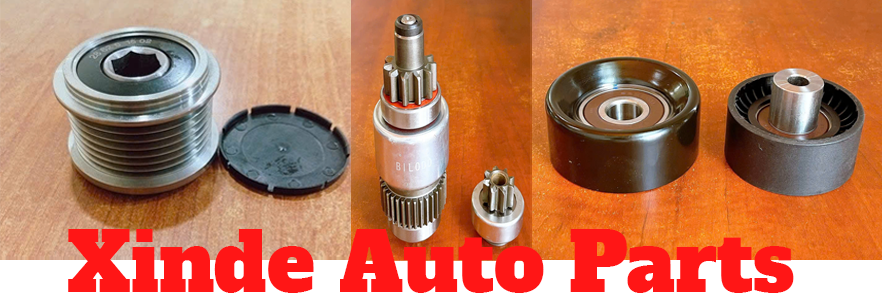
An Overrunning Alternator Pulley (OAP) incorporates a precision one-way roller clutch and internal needle support bearings, performing a vital mechanical decoupling function:
Empirical Performance Gains with OAP Integration:
- Free-Wheeling Action: When the crankshaft decelerates, the one-way clutch instantly disengages, allowing the alternator rotor to "freewheel" smoothly at its own inertial speed without dragging the belt backward.
- Dynamic Vibration Damping: Multi-body dynamics simulations confirm that OAPs eliminate up to 65% to 75% of dynamic belt tension peak loads during rapid gear shifts and start-stop cycles.
- NVH Reduction: Eliminates low-frequency booming noise and belt chirping inside the passenger cabin, delivering factory-original acoustics.
3. Critical Manufacturing and Metallurgical Benchmarks
Because OAPs and tensioner pulleys operate under extreme radial forces at speeds up to 18,000 RPM, manufacturing precision determines operational reliability:
- Clutch Roller Hardness: Internal sprag/roller clutches are machined from premium chrome steel (GCr15/100Cr6), through-hardened to HRC 60–64 to prevent roller brinelling under sudden torque spikes.
- High-Temperature Lubrication: Units are factory-sealed with specialized polyurea or ester-based synthetic greases rated from -40°C to +180°C, ensuring zero grease leakage past the multi-lip elastomeric seals.
- Dynamic Balance Verification: Every pulley undergoes automated two-plane dynamic balancing, ensuring eccentric runout remains strictly within ≤ 0.03 mm to protect alternator front bearings.
Commercial Takeaway for Distributors: The "Bundled Replacement" Strategy
When an alternator pulley clutch seizes, it acts like a rigid pulley, transferring destructive shock loads directly to the tensioner pulley. Sourcing and recommending FEAD component pairs (OAP + Tensioner Pulley) ensures that workshops resolve root-cause vibrations in a single service visit, eliminating customer comebacks and doubling aftermarket order value for importers.